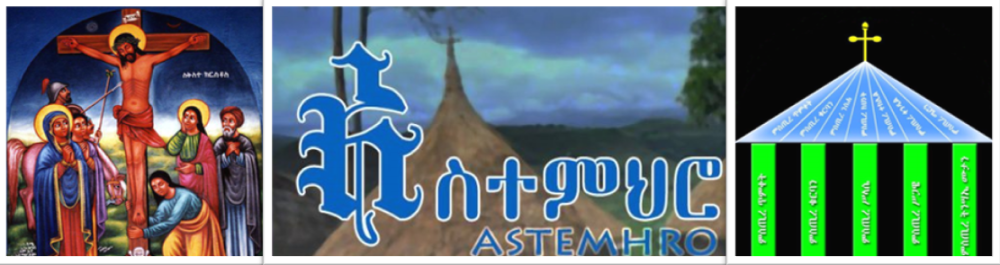
The five pillars of mysteries are the core elements of faith in the Ethiopian Orthodox Tewahedo Church. They define the Church’s doctrine and form the foundation of all preaching, sacraments, and services. This article offers a brief introduction to these five pillars of mysteries. We will also provide separate articles that explore each mystery in greater depth.
Definition of terms
Let’s begin by defining several key terms that will help us better understand the five mysteries. These foundational concepts are God, Faith, Religion, Dogma, Canon, and Church.
God is Pantocrator—the Creator and Ruler of the entire universe (Gen 1:1). He is the Lover of all humankind, the Heavenly Father, and the source of all moral authority. God is the Supreme Being, the Almighty, and the Truth. He is omniscient (knowing all), omnipresent (present everywhere), omnipotent (able to do all things), eternal, and merciful. This is the God in whom we believe.
Faith is our firm conviction in God. It means believing in Him with our whole being. Accordingly, faithfulness involves believing in God with the heart, confessing our faith with the mouth, and manifesting it through our actions (Romans 10:9). The Apostle Paul describes faith as “the substance of things hoped for and the evidence of things not seen” (Hebrews 11:1).
Religion is a distinct yet related concept. It refers to an organized expression of faith. Religion outlines the nature of our relationship with God and describes how we worship Him both individually and as a community. It also presents the true path to eternal life, based on the Word of God as revealed in the Holy Scriptures. Within the term religion are included the institutional structures, traditions, and various forms of service practiced at all levels of the Church.
Dogma refers to the foundational anchors of faith—most notably, the Five Pillars of Mysteries. Dogma articulates the essential principles at the heart of our belief. These truths are professed and upheld by all the faithful. What is declared as Dogma is a set of principles established as incontrovertibly true by the Holy Synod. Any deviation from the Dogmas of our religion is regarded as heresy.
Canon refers to the ecclesiastical laws and rules (1 Cor. 14:40) that govern the Church. These canons are formulated by the Holy Synod and are binding on all churches. They may be amended by the Holy Synod when necessary. The canons include regulations related to liturgical services, the priesthood, church administration, and other aspects of ecclesiastical life.
Church (Ecclesia) is understood in four complementary ways. First, it refers to the congregation (1 Cor. 11:28)—the unity of all Christians, including those in heaven, and the union of believers with Christ. Second, it refers to the system of worship (John 2:16)—the church building as a place of worship and the spiritual services conducted within it. Third, the term refers to the spiritual life of individual Christians (1 Cor. 3:16), for each believer is a temple of God. Finally, Church can describe the entire religious institution, such as the Ethiopian Orthodox Tewahedo Church or the Coptic Orthodox Church.
The Pillars of Mysteries
A pillar is a vertical structure that rises from a foundation and supports the superstructure of a building. In a similar way, the Pillars of Mysteries are the most important elements of faith and the basic principles of belief. They are called pillars because they serve as the anchors and supports of our faith.
Why do we call them ‘Mysteries?
We call these pillars of faith “mysteries” for two main reasons. First, they are divine truths revealed by God (1 Cor. 2:7–8). The human mind cannot fully comprehend or explain them (1 Cor. 2:9). They cannot be exhaustively conceptualized or understood through reason alone. For example, to a non‑believer, the mystery of Baptism may appear to be nothing more than washing with water. Yet through it, a person becomes a son or daughter of God by grace—something physically indescribable. This is why our Lord Jesus Christ taught Nicodemus, saying: “The wind bloweth where it listeth, and thou hearest the sound thereof, but canst not tell whence it cometh, and whither it goeth: so is every one that is born of the Spirit.” (John 3:8)
Second, we call them mysteries because they are revealed to those who believe in God. Just as a person discloses the details of a treasure only to his or her heirs, God reveals the mysteries of faith to those who seek Him with a pure heart. For this reason, our Apostolic Church does not permit non‑believers to participate in the sacraments, which are the visible expressions of our faith in the Five Pillars of Mysteries. One must first learn and profess these pillars before becoming a full member of God’s Kingdom within the Apostolic Orthodox Church.Our Lord Jesus Christ taught: “Give not that which is holy unto the dogs, neither cast ye your pearls before swine, lest they trample them under their feet, and turn again and rend you.” (Matthew 7:6)
What are the Five Pillars of Mysteries?
The Five Pillars of Mysteries of the Ethiopian Orthodox Tewahedo Church are: the Mystery of the Holy Trinity, the Mystery of the Incarnation, the Mystery of Baptism, the Mystery of the Holy Eucharist, and the Mystery of the Resurrection of the Dead.
What’s the basis for Pillars of Mysteries?
The Five Pillars of Mysteries are grounded in the Holy Bible—the teachings of our Lord and Savior Jesus Christ and His apostles. At the center of these mysteries stands the Creed of Faith, which summarizes the declarations of the three Ecumenical Councils recognized by the Oriental Orthodox Church: the Councils of Nicaea, Constantinople, and Ephesus.
The Orthodox Creed of Faith
We believe in one God, God the Father the Pantocrator who created heaven and earth, and all things seen and unseen. We believe in one Lord Jesus Christ, the Only-Begotten Son of God, begotten of the Father before all ages; Light of Light, true God of true God, begotten not created, of one essence with the Father, by whom all things were made; Who for us men and for our salvation came down from heaven, and was incarnate of the Holy spirit and the Virgin Mary and became Man.
And He was crucified for us under Pontius Pilate, suffered and was buried. And on the third day He rose from the dead, according to the scriptures, ascended to the heavens; He sits at the right hand of his Father, and He is coming again in His glory to judge the living and the dead, Whose kingdom shall have no end.
Yes, we believe in the Holy Spirit, the Lord, the Life-Giver, Who proceeds from the Father, Who with the Father and the Son is worshipped and glorified, who spoke by the prophets. And in one holy, catholic and apostolic church. We confess one baptism for the remission of sins. We look for the resurrection of the dead, and the life of the coming age. Amen.
Why should we learn about the Pillars of Mysteries?
Learning the Pillars of Mysteries helps us understand our faith and our religion more deeply. A clearer understanding of these mysteries also equips us to guard ourselves—and our fellow Christians, against various forms of heretical teachings. Knowledge of the Pillars of Mysteries paves the way toward righteousness and leads us on the path to eternal life.
You may be wealthy, educated, or powerful in this earthly life. You may hold great authority on earth. But have you ever considered how long you will remain here? How much do you truly know about your profession or any other aspect of worldly life? Certainly, you know much, and you continue learning every day. But what do you know about your destiny after death?
As Christians, we know that we await eternal life after death. The Five Pillars of Mysteries are the starting point of our spiritual understanding, truths revealed through Scripture, that prepare us to become worthy heirs of eternal life. If we rely on God to fulfill our earthly needs and desires, how much more should we rely on Him to help us understand the mysteries of our Apostolic Orthodox Christian faith? As St. Paul teaches: “If in this life only we have hope in Christ, we are of all men most miserable.” (1 Cor. 15:19) Therefore, we study the Pillars of Mysteries so that we may grasp the foundations of our Christian faith and lift our eyes beyond this world toward the Kingdom of God.
May God grant us the wisdom to understand His holy mysteries. Amen.
 አስተምህሮ ዘተዋሕዶ
thanks for teaching. keep it up
LikeLike
It is clear and basic to know our religion. But include morelessons with such clarity.
LikeLike